application
RillDNS
active
Compact CoreDNS operations stack with authenticated replication, managed blocking, APIs, UI, and monitoring.


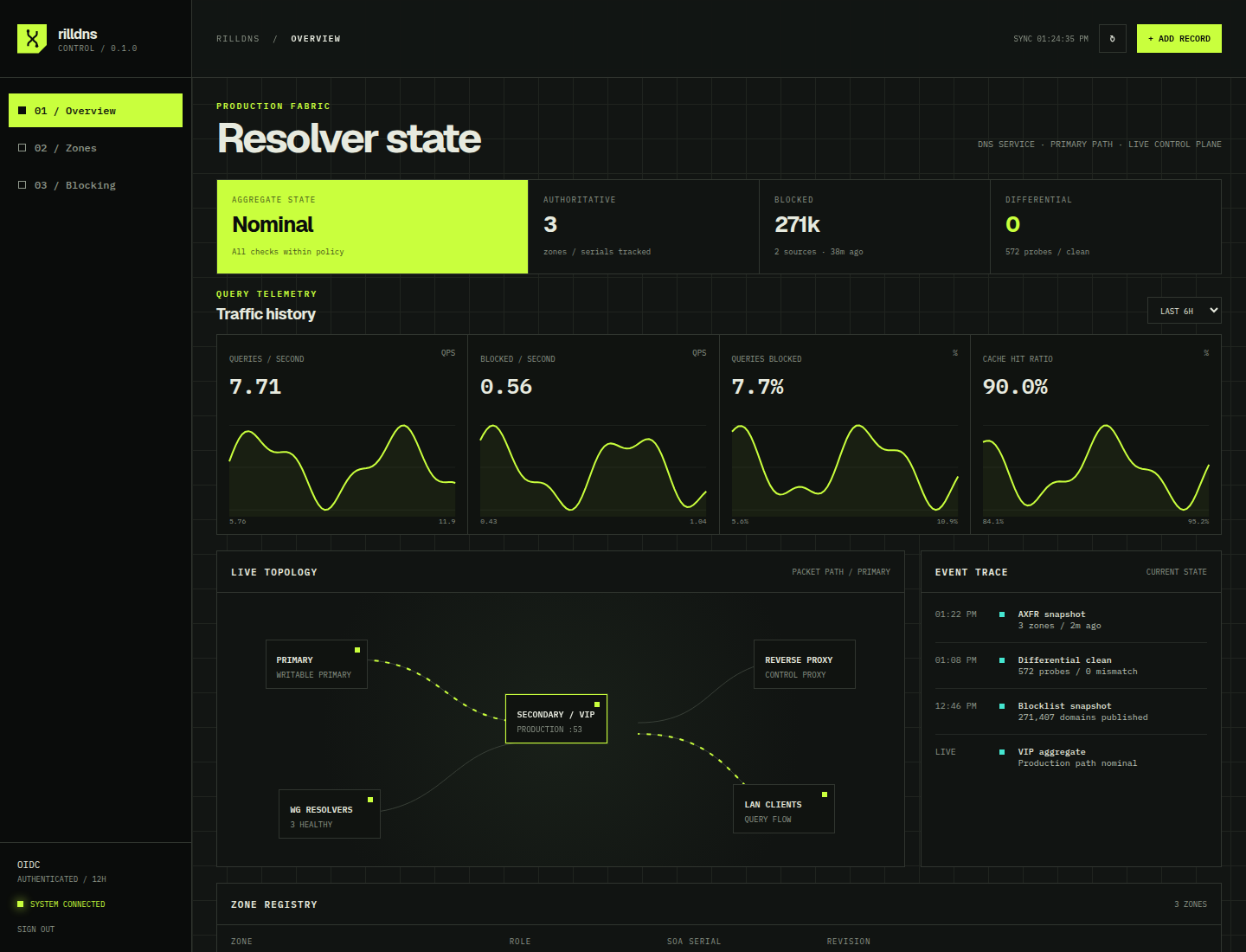
RillDNS is a compact DNS operations stack built around CoreDNS. It combines authoritative zone management, forwarding and caching, authenticated primary/secondary replication, managed ad blocking, a Go API and MCP server, an OIDC-protected web console, differential checks, and Prometheus monitoring.
For a first server deployment, use the sanitized, variable-driven Ansible playbook. It keeps real inventories, zones, and secrets outside the public repository and validates required settings before changing either node.
It is intended for experienced self-hosters and small infrastructure teams. RillDNS is not a hosted service or a turnkey replacement for understanding DNS, firewalling, backups, and key management.
Highlights
- Atomic, revisioned zone and RRset changes with dry-run plans and audit logs
- TSIG-authenticated NOTIFY and AXFR replication with last-known-good snapshots
- UDP/TCP differential probes across authoritative records and edge cases
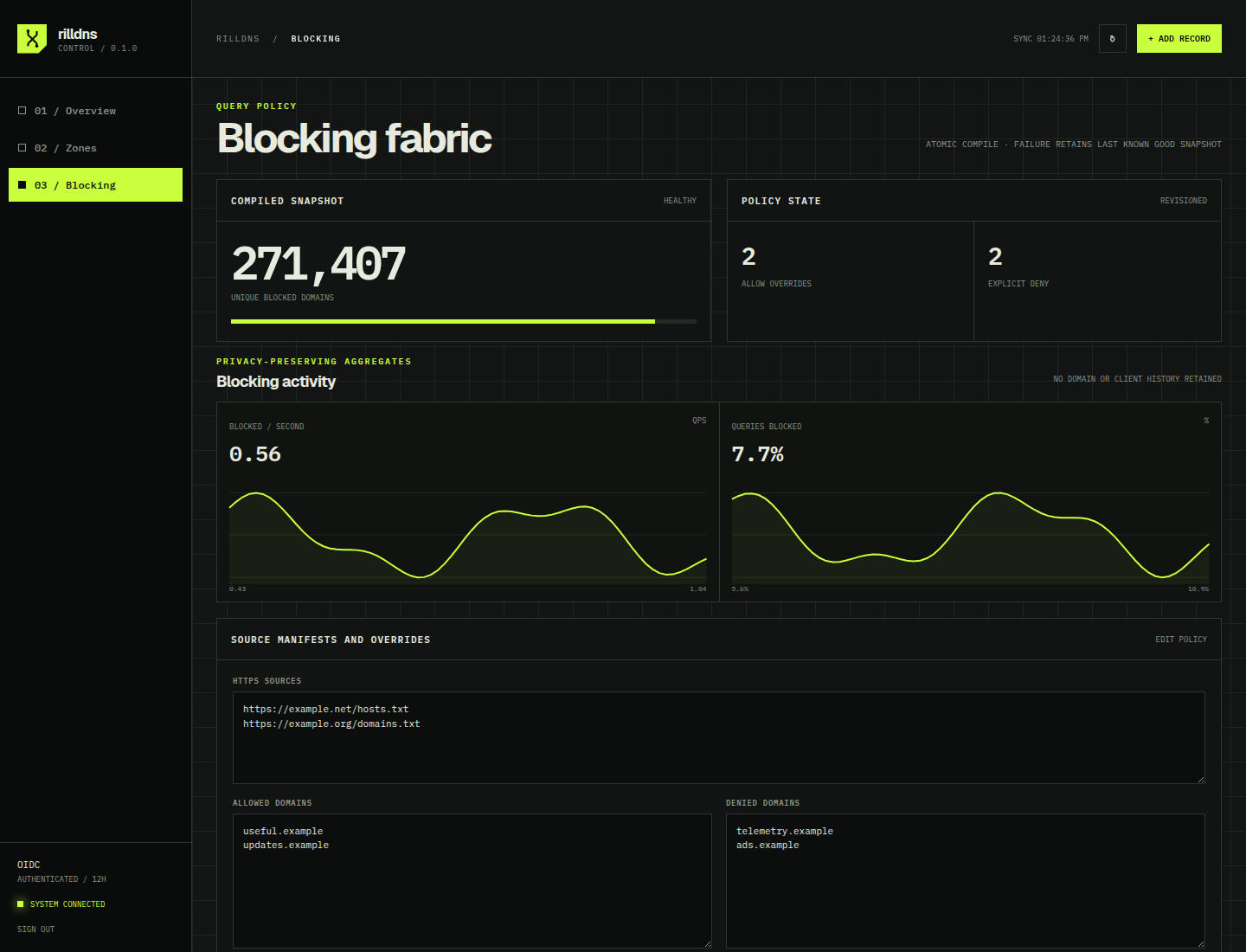
- Daily compiled hosts/domain blocking with allow and deny overrides
- Configurable query analytics with aggregate-only privacy by default, bounded top-domain/client statistics, and an optional short recent-query view
- REST management API and SSH-stdio MCP tools
- OIDC Authorization Code + PKCE web console
- Health, readiness, CoreDNS, refresh, replication, and differential metrics
Try it locally
Requirements: Docker with Compose, Go 1.27.1 or later, dig, and curl.
The local Compose fixture listens on 127.0.0.1:1053 and uses only reserved
example names and addresses:
dig @127.0.0.1 -p 1053 www.example.test A
dig @127.0.0.1 -p 1053 ads.example.test A
dig @127.0.0.1 -p 1053 example.com A
curl http://127.0.0.1:9153/metrics
Stop it with make down.
Architecture
The reference production model uses two native CoreDNS nodes:
                         HTTPS / OIDC
                              │
                       reverse proxy
                              │
                primary API ─── backup ─── secondary API
                 writable                    read-only
                      │    TSIG NOTIFY/AXFR      │
                      └──────────┬───────────────┘
LAN clients ──────────────── DNS VIP ───────────── upstream resolvers
                                  │
                           Prometheus metrics
See production deployment, the
API reference, high availability,
operations and recovery,
MCP setup, and
web UI configuration. Files under deploy/ are sanitized
examples and must be adapted to your addresses, zones, firewall, and identity
provider.
Repository layout
cmd/                       Go commands and services
internal/api/              REST API and Prometheus history queries
internal/webui/            embedded OIDC-protected console
internal/zones/            validated atomic zone store
internal/secondary/        persistent authenticated replication
internal/querytelemetry/   aggregate-only dnstap collector
config/                    local Compose CoreDNS configuration
data/                      local fixtures and blocklist policy
deploy/                    example systemd, nginx, and Prometheus files
docs/                      operations and API documentation
Security and privacy
Secrets are read from root-owned files or environment variables and must never
be committed. Query telemetry defaults to aggregate mode, which compares each
name against the in-memory block set, increments aggregate counters, and
immediately discards the name and client address. Identifier-bearing
statistics and detailed modes require explicit deployment configuration and
enforce bounded retention. See SECURITY.md for reporting and the
current security model.
Status
RillDNS is operational software extracted from a real deployment, but its public interfaces may still change. Native DNSSEC key management and signing are not implemented; do not use it for zones that require RillDNS to maintain a DNSSEC trust chain.
Contributing
Bug reports and focused pull requests are welcome. Read CONTRIBUTING.md before submitting changes.
License
RillDNS is available under the MIT License.